10 June 2013
"For the Sake of the Trust" [MUSG]
Posted by Scott Monty at 2:21 AMThe Baker Street Irregulars are widely known as a literary society dedicated to the study of Sherlock Holmes. Since 1934 the group has been gathering in New York City for its annual dinner and weekend festivities and has embarked on a significant publishing effort centered around its own history, international Sherlockian societies' scholarship, and analysis of extant manuscripts of the Canon.
But more than that, the BSI wants to ensure that its own history and that of its members are recorded for posterity and the researchers who may be interested in it sometime in the future. Enter the Baker Street Irregulars Trust.
In Episode 53 of I Hear of Sherlock Everywhere, Burt and Scott interview Tom Francis, BSI ("The Imperial Opera at Warsaw), who is the Chair of the Trust. Tom helps us understand how and why the Trust was established, what its aims are, and how you can help this august institution. We discuss some of the holdings of the Houghton Library at Harvard University, where the Trust is housed, including the H.W. Bell collection - Bell having been an early Sherlockian scholar and member of The Speckled Band of Boston.
11 March 2013
"Acquired By Long and Patient Study" [STUD]
Posted by Gordon D at 2:21 PMThankfully, we now have Maria Konnikova's Mastermind: How to Think Like Sherlock Holmes (available on Amazon as a hardcover, paperback or Kindle edition) a fascinating book that not only marries Victorian detection to current-day thought, but manages to provide an illuminating, insightful work for both Sherlockians and casual fans alike. Mastermind focuses on how much of what we understand about learning, decision-making, and deductive ability can be derived from Holmesian thought (as expressed in the canon).
Each discussion has an underpinning in the canon, from how "facts" can influence our first impressions (see Mary Morstan) to the proper care and maintenance of the "brain attic", Mastermind takes much of its lead from key stories in the canon. (In fact, towards the end Mastermind cleverly demonstrates how Holmes' cognitive abilities have developed over time, citing both early and later Conan Doyle stories).
29 October 2012
"You Like This Weather?" [CHAS]
Posted by Scott Monty at 3:53 PMAnd while we don't profess to be meteorologists (nor do we play one on TV), we thought that we might be able to think about Sherlock Holmes through the lens of severe weather.What does the weather have to do with Sherlock Holmes? Quite a bit, as it turns out.
We'd like to invite your ideas, memories and input to help us discern exactly how weather played a role in the Sherlock Holmes stories. You can do that by leaving a comment below. We'll get things started by enumerating a few items that might get you thinking.
05 March 2012
"If the Matter Is Beyond Humanity..." [DEVI]
Posted by Gordon D at 2:21 AMThat would be a mistake, for as Stephen Kendrick suggests in his book Holy Clues, many spiritual lessons can be learned from Holmes' approach. (Recently, I had an opportunity to revisit the book, having read it a few years ago)
Subtitled "The Gospel According to Sherlock Holmes," the book uses Holmes' approach - with a liberal helping of other thinkers - to suggest a way of approaching spirituality through a more skeptical lens. Granted, the book may tactfully avoid the darker aspects of the canon, but Kendrick provides multiple examples of ways in which a Holmesian approach may strengthen one's spiritual convictions.
Thankfully, there is an open approach towards integrating different trains of spiritual thought, with Zen/Buddhist concepts given equal weight with Judeo-Christian ideas. It's a book that provides a great deal of enlightenment, and that may spark a great deal of debate and discussion amongst Holmes aficionados.
Granted, this is an unusual approach to the canon - treating it as a way of determining a spiritual lifestyle. Kendricks, however, manages to perform an impressive feat in Holy Clues, suggesting that matters beyond humanity are not necessarily beyond anyone....including Holmes.
Very highly recommended.
Have you read it? We would be interested in your opinion in the comments below.
Editor's note: Gordon regularly covers the intersection of Sherlock Holmes and the entertainment industry. You can also find him at Blog THIS, Pal! and Comic Related.
--
08 April 2011
“I Would Rather Have Toby’s Help" [SIGN]
Posted by Jennifer M. Emerson at 2:21 AM
Anyway, back to the dogs. Due to primitive methods, those police canines were not afforded the chance to prove as useful as they could have been. But in his own case, Holmes gave the scrappy Toby the opportunity to use his “most amazing power of scent” unhampered by police regulations or botched test sites. In his account of the case, Dr. Watson tells us just what the master did:
“He pushed the creosote handkerchief under the dog’s nose…The creature broke into a succession of high, tremulous yelps, and, with his nose on the ground, and his tail in the air, pattered off upon the trail at a pace which strained his leash and kept us at the top of our speed.”It was simple, yet highly effective. Dr. Watson may have described Toby as having “a very clumsy, waddling gait”, but this furry ally proved his worth in short order. And in so doing, he vindicated his colleagues and brought literary glory to his species. As Holmes said, Toby “acted according to his own lights”. Holmes could just as well have been explaining himself here, and makes an excellent point about his beloved powers of deduction: that one must trust one’s instinct in order to ‘sniff out’ the true scent from the false ones.
If Toby wasn’t the guest of honor at their wedding, he should have been!
[Editor's note: Our guest author Jennifer has had a life-long interest in English and American literature (particularly of the 19th century), and grew up watching both the Rathbone/Bruce & the Granada incarnations of Holmes and his Boswell. Some of her favorite authors are Charles Dickens, George Gordon Lord Byron, Sir Arthur Conan Doyle, Washington Irving and Edgar Allan Poe. One of her two current efforts include research into the Holmes Canon for a collection of short stories centered around Dr. Watson. The other is a historic fiction novel-in-progress dealing with reform methods for London prostitutes in the Victorian Era. She has a decade of experience in the field of 19th century living history, and enjoys sharing little tidbits and musings on her blog.]
--
06 April 2011
"In My Anxiety to Oblige the Pope" [HOUN]
Posted by Ann Margaret Lewis at 2:21 AM![]() |
| Pope Leo XIII |
![]() |
| Leo XIII endorsed a vintage spiked with cocaine. |
| Holmes as "the venerable Italian priest" looking a lot like Pope Leo XIII. |
20 February 2011
"This Insignificant-Looking Man Inspired Me" [GREE]
Posted by Unknown at 2:21 AMSherlock Holmes is a myth, a demi-god; a fictitious, heartless, blindly intelligent, insightful and confident Übermensch. Everything we want and need to be in a rapidly changing technologically-driven world. He could never be real.
Or could he?
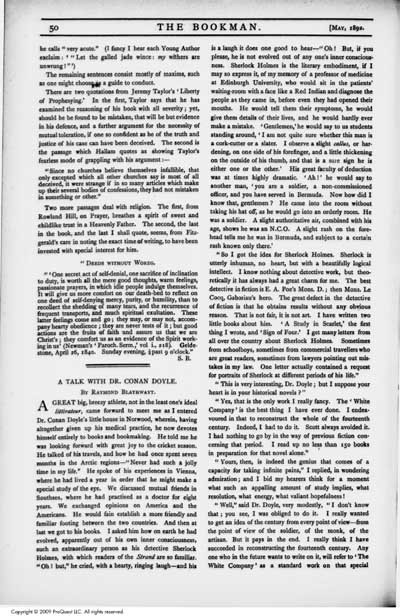
When Conan Doyle was attending the University of Edinburgh as a medical student he attended a class with Dr. Joseph Bell. According to Doyle’s 1892 Interview with the Bookman:
[Bell] would sit in the patients’ waiting-room with a face like a Red Indian and diagnose the people as they came in, before even they had opened their mouths. He would tell them their symptoms, he would give them details of their lives and he would hardly ever make a mistake…His great faculty of deduction was at times highly dramatic. ‘Ah!’ he would say to another man, ‘you are a soldier, a non-commissioned officer, and you have served in Bermuda. Now how did I know that, gentlemen? He came into the room without taking his hat off, as he would go into an orderly room. He was a soldier. A slight authoritative air, combined with his age, shows that we was an N.C.O. A slight rash on the forehead tells me he was in Bermuda, and subject to a certain rash known only there.’ So I got the idea for Sherlock Holmes.
Bell was well known for more than just being the original Sherlock Holmes. He was also considered to be an expert witness, who often took the stand at some of the more sensational murder trials during the latter half of the century.
For more information on the Bookman and the origins of Holmes, see our recommended reading below. - Ed.
--
![]() |
| Available from Wessex Press |
05 July 2010
"This Account of You We Have From All Quarters Received" [SCAN]
Posted by Scott Monty at 9:51 PMThe German Sherlock Holmes magazine is now in its fourth issue and is clearly popular, as the first issue from August 2009 has sold out, and the second issue is nearly sold out. To give you an idea of what made it so popular (aside from the notion of a first issue being something of a collector's item), here are some of the topics from that first appearance (very loosely translated - forgive our crude skills):
- What do we really know about Sherlock Holmes and Dr. Watson?
- The Victorians and the love of money
- Ongoing thoughts on the Canon
- Events in the anniversary year
- Reviews
- From the press
- Pastiche
In the June 2010 edition, comprising 32 pages of full color, we have the following to look forward to:
- Theater: The Hound of the Baskervilles in Hamburg
- Baker Street: the new comic series
- Sherlock Holmes and the movement of death
- From the research:
- Sir Arthur Conan Doyle - War of the Ghosts
- Scotland Yard
- from the press
- Pastiche
There is sure to be something for everyone here - both collectors and active Holmesians in Germany as well. The publishers are the Deutsche Sherlock Holmes Gesellschaft and the subscription rates are as follows: 19 € to the UK, 27 € within the EU, 32 € worldwide. You can order here.
Related items for you Germanophiles:
14 December 2009
"A Very Workmanlike Little Bit of Analysis" [VALL]
Posted by Scott Monty at 6:55 AMAny time a film is inspired by a book, one will see the inevitable comparison between the two. It's really somewhat of a false game, as each medium is intrinsically designed to bring the viewer or reader on a journey that involves different sensory areas of the brain. Without sounding too Holmes-like, it's about connecting to emotions, logic and senses, and each medium does so differently. Which is why we rarely see a movie that's just like it's written counterpart.
Over the next few weeks, we'll see all sorts of movie reviews (and not only on this site!
But here, courtesy of Randall Stock, BSI ("South African Securities") we're delighted to see a writeup of the new Sherlock Holmes film that includes a serious number of references to the original Canon and do so in a very creative way.
If you have a moment, please take a look at the Paste Magazine review Film Friday: Comparing Ritchie's Sherlock Holmes to Conan Doyle's Stories by Robert Davis. Two things spring to the eye. The first is that Davis states: "I don’t think I’ve ever been spotted defending a Guy Ritchie movie, and I’m not yet convinced that I’ll defend his latest... but I’m eager to defend its subject." This is a good start.
The second is one how he does it. Davis proceeds to analyze some of the actions of the characters and then finds Canonical references that support or refute the activities - and he does so with Canonical quotations, backed by Google Books. His links to the stories are direct, so the reader can see exactly in which stories the quotes appeared and in what context. It's a bibliography for the Information Age. Please check it out if you have a moment.
27 December 2007
"A Certain Annual" [SPEC]
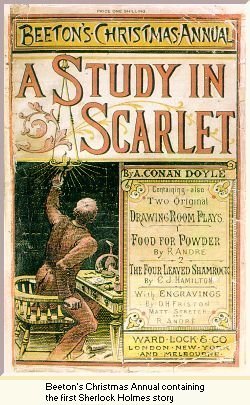
Posted by Scott Monty at 12:43 AMFor anyone reading this blog, there has never been a time when the world as you know it has been without Sherlock Holmes. As a matter of fact, it's been exactly 120 years since Sherlock Holmes made his first appearance in the Beeton's Christmas Annual. For a short summary of Holmes's humble beginnings, you can listen to a segment on All Things Considered that NPR ran on December 23.
And in our own humble way, we honor his memory over at the Baker Street Journal. Each year for the last 10 years, we've been offering an additional companion piece to our quarterly journal - something we call the Baker Street Journal Christmas Annual.
The Christmas Annual for 2007 is about to hit the streets, and we've already got a record number of subscribers signed up to receive it. If you are renewing your BSJ subscription or if you're taking a subscription out for the first time, you can automatically include the Annual as part of your package, and receive a discount in the process. So, sign up now for the 2008 Journal & Annual.
In the meantime, let's focus on what we've got in 2007. The title of this year's entry is:
Rathbone Returns: A Misadventure Called Sherlock Holmes by S.E. Dahlinger, ASH and Glen Miranker, BSI ("The Origin of Tree Worship")Basil Rathbone is still a perennial favorite of many Holmes enthusiasts. As a matter of fact, I recently met a 9 year-old who came to a dinner of the Friends of Irene Adler in Cambridge, MA dressed as the great detective - and he himself told me that Basil Rathbone was the best Sherlock Holmes ever. We could argue that here or in a variety of forums forever, but let's say that by the end of his 14 film stretch and radio play, Rathbone was inexorably typecast.
Indeed, he was just as eager to push Sherlock Holmes over the precipice at Reichenbach Falls as Arthur Conan Doyle had been. As he wrote in his autobiography, In and Out of Character:
I was . . . deeply concerned with the problem of being "typed," more completely "typed" than any other classic actor has ever been or ever will be again. . . . There was nothing I could do about it, except to stop playing Mr. Holmes. . . .That June, Rathbone and his wife Ouida left Hollywood for the New York stage in search of better things. At least, that was the plan. They quickly found that Broadway wouldn't touch Basil as anything other than Holmes, either. Rathbone began casting about for the play in which to rekindle his rapidly fading star—and fell back on his wife to write it.
Thereby hangs our tale of Sherlock Holmes by Ouida Rathbone. It may have been a comedy, or it may have been a tragedy. It cost one man his dream of conquering Broadway in his most notable role. It cost another man his career as a Broadway producer. It gave yet a third man a heart attack at the dress rehearsal. It even caused the Conan Doyle Estate to forget that the script had ever been produced in the first place. Yet there was certainly an element of comedy.
The play opened here in Boston (as did many plays of the day before hitting the Great White Way). Peter Blau even mentioned planning on seeing it in New York after its Boston run. If you pick up a copy of the Annual, you'll see what happened in the process.
So, as a birthday present to Holmes and as a happy Blue Carbuncle Day ("the second morning after Christmas"), order your copy - and sign up for a subscription and next year's Annual while you're at it, over at bakerstreetjournal.com.
14 September 2007
"It Is the Bootmaker" [LADY]
Posted by Scott Monty at 6:26 AMI'm pleased to report that the Bootmakers of Toronto have released the latest issue of their quarterly magazine, The Canadian Holmes. If you're at all interested in Sherlockian scholarship, this is one of the top publications you can subscribe to. The others are The Baker Street Journal, The Sherlock Holmes Journal and The Serpentine Muse.
Of particular note with regard to this issue of this northern publication is that it is the first issue over which Barbara Roden has presided as editor. As her husband Christopher points out:
It's packed from cover to cover with fascinatingCongratulations to Barbara on her debut!
material, including an article by Richard Lancelyn Green on the
manuscript of 'Shoscombe Old Place' and - those of you who were in
Minneapolis recently will recognise the significance of this - a
revelatory article by Michael Dirda on Langdale Pike.
08 September 2007
"There Is This Naturalist" [HOUN]
Posted by Scott Monty at 10:02 PMThe history of the San Diego Natural History Museum is rich and deep, as it is the oldest scientific institution in southern California and only the second oldest west of the Mississippi River. It is even more interesting to us because it contains a Sherlockian connection.
One of the museum's major historical was an amateur naturalist, Dr. Laurence M. Klauber, who had a wide variety of interests. Although he became CEO of San Diego Gas & Electric, his passion fueled his hobbies - two of which intersected for an interesting outcome.
You see, Dr. Klauber was a herpetologist - a person who makes a study of snakes. He wrote over 100 papers on snakes and lizards, identified 53 species and left a collection of more than 36,000 reptile and amphibian specimens to the museum. In addition, he was an inveterate collector and bibliophile who amassed 1462 books, 19,000 pamphlets, 20 drawers of hand-written catalog cards, and 198 looseleaf binders of scientific notes related to snakes.
Naturally, a bookman with an interest in snakes can only lead to one story: The Adventure of the Speckled Band. It was this combination of interests that led Dr. Klauber to write an article for Vol. 3, No. 2 of the Baker Street Journal in 1948, called The Truth About the Speckled Band. You can click on the link and read it for yourself.