Showing posts with label reference. Show all posts

10 June 2013

"For the Sake of the Trust" [MUSG]

[This is a cross-post of our sibling publication I Hear of Sherlock Everywhere.]

The Baker Street Irregulars are widely known as a literary society dedicated to the study of Sherlock Holmes. Since 1934 the group has been gathering in New York City for its annual dinner and weekend festivities and has embarked on a significant publishing effort centered around its own history, international Sherlockian societies' scholarship, and analysis of extant manuscripts of the Canon.

But more than that, the BSI wants to ensure that its own history and that of its members are recorded for posterity and the researchers who may be interested in it sometime in the future. Enter the Baker Street Irregulars Trust.

In Episode 53 of I Hear of Sherlock Everywhere, Burt and Scott interview Tom Francis, BSI ("The Imperial Opera at Warsaw), who is the Chair of the Trust. Tom helps us understand how and why the Trust was established, what its aims are, and how you can help this august institution. We discuss some of the holdings of the Houghton Library at Harvard University, where the Trust is housed, including the H.W. Bell collection - Bell having been an early Sherlockian scholar and member of The Speckled Band of Boston.


11 March 2013

"Acquired By Long and Patient Study" [STUD]

Examining the "Science of Deduction and Analysis" is a singular activity - many Holmesian scholars have managed to find interesting nuances when focusing on the Great Detective's skills. With the plethora of Holmes-related media in recent years, it would seem that reconciling Holmes' unique talents to modern-day psychology might be a bit daunting.

Thankfully, we now have Maria Konnikova's Mastermind: How to Think Like Sherlock Holmes (available on Amazon as a hardcover, paperback or Kindle edition) a fascinating book that not only marries Victorian detection to current-day thought, but manages to provide an illuminating, insightful work for both Sherlockians and casual fans alike. Mastermind focuses on how much of what we understand about learning, decision-making, and deductive ability can be derived from Holmesian thought (as expressed in the canon).

Each discussion has an underpinning in the canon, from how "facts" can influence our first impressions (see Mary Morstan) to the proper care and maintenance of the "brain attic", Mastermind takes much of its lead from key stories in the canon. (In fact, towards the end Mastermind cleverly demonstrates how Holmes' cognitive abilities have developed over time, citing both early and later Conan Doyle stories).

10 February 2012

"I Have Had No Proof Yet" [SIGN]

Recently, Sherlocktron, a long-time Internet information center for Sherlock Holmes, was forced to move to a new Internet service provider at http://sherlocktron.hostoi.com/Sherlocktron.html.

The site owner, Willis Frick, has now updated the files at the new web site. But he he is looking for your help to make sure the listings are up to date.

At this point, he has been able to verify the Web addresses (URLs) and email addresses of the purveyors of Sherlockian items and of the society publications listed. However, many Sherlockian purveyors and societies do not have a means to contact them electronically to verify the information - and that is where he needs your help, dear readers.

Please take a few minutes to looks at these files:
Sherlockian Publication List (PDF)
Sherlockian Purveyor List (PDF)

If there are any additions, corrections or deletions required, please notify Willis by email: sherlock1 [AT] cox [DOT] net. 


For information about these lists see: 
About Sherlockian Publications (PDF)
About Sherlockian Purveyors (PDF)

It would be a wonderful gesture to extend to Willis, as he finishes up this project. After all, someday you may be looking for something Sherlockian or for a newsletter from a society, and this resource may come in handy.


--

08 April 2011

“I Would Rather Have Toby’s Help" [SIGN]


One of the endearing and distinguishing characteristics of Sherlock Holmes was his penchant for thinking outside the box. Free of the constraints of police regulations, Holmes’s methods often extended beyond the realm of the traditional. Thank goodness.

According to William Baring-Gould's The Annotated Sherlock Holmes (1992 edition), the case of The Sign of Four (published by Lippincott's Monthly Magazine in February of 1890), lasted from Tuesday 18 September to Friday 21 September, 1888. Thus, the mystery of the Agra Treasure, a case unlike any other, was solved in only four days time. But how?

Fortunately, Holmes knew that an unlikely case calls for unlikely tactics. And the master would not have cracked the case without the help of a very special individual. A four-legged individual by the unlikely name of Toby, of No.3 Pinchin Lane, Lambeth.

This got me thinking. And when that happens, like any good Holmesian (or Sherlockian, whichever you prefer), I mounted a search for facts. My findings are as follows:

By the late 19th Century, dogs had been used by mankind for over a millenium in war, domination of new lands, and hunting. Bloodhounds had been used for the aforementioned reasons for the past three hundred years. In addition, some policemen had taken to bringing their own dogs with them on their beats. The London Police Force incorporated bloodhounds during the Jack the Ripper murders, which occurred in August-November of 1888 – the very same time that a certain consulting detective who had recently come into public prominence was employing a "long-haired, lop-eared creature, half spaniel and half lurcher, brown and white in colour" to assist him [SIGN]. In fact, Holmes's case began just ten days after the murder of Annie Chapman! As Brett's Holmes remarked in Granada's 'The Dying Detective': "Coincidence bordering upon the unbelievable!"


Anyway, back to the dogs. Due to primitive methods, those police canines were not afforded the chance to prove as useful as they could have been. But in his own case, Holmes gave the scrappy Toby the opportunity to use his “most amazing power of scent” unhampered by police regulations or botched test sites. In his account of the case, Dr. Watson tells us just what the master did:
“He pushed the creosote handkerchief under the dog’s nose…The creature broke into a succession of high, tremulous yelps, and, with his nose on the ground, and his tail in the air, pattered off upon the trail at a pace which strained his leash and kept us at the top of our speed.”
It was simple, yet highly effective. Dr. Watson may have described Toby as having “a very clumsy, waddling gait”, but this furry ally proved his worth in short order. And in so doing, he vindicated his colleagues and brought literary glory to his species. As Holmes said, Toby “acted according to his own lights”. Holmes could just as well have been explaining himself here, and makes an excellent point about his beloved powers of deduction: that one must trust one’s instinct in order to ‘sniff out’ the true scent from the false ones.
And while the contributions of the Baker Street Irregulars should not be overlooked, it was Toby who turned the chase in the right direction. Without Toby’s help, the boys would have had no Aurora to find, Small would never have been caught, readers would have been deprived of one of the most memorable boat chases in all of literature…and most importantly, Dr. John H. Watson would not have won the heart of Miss Mary Morstan.

If Toby wasn’t the guest of honor at their wedding, he should have been!


[Editor's note: Our guest author Jennifer has had a life-long interest in English and American literature (particularly of the 19th century), and grew up watching both the Rathbone/Bruce & the Granada incarnations of Holmes and his Boswell. Some of her favorite authors are Charles Dickens, George Gordon Lord Byron, Sir Arthur Conan Doyle, Washington Irving and Edgar Allan Poe. One of her two current efforts include research into the Holmes Canon for a collection of short stories centered around Dr. Watson. The other is a historic fiction novel-in-progress dealing with reform methods for London prostitutes in the Victorian Era. She has a decade of experience in the field of 19th century living history, and enjoys sharing little tidbits and musings on her blog.]


--

06 April 2011

"In My Anxiety to Oblige the Pope" [HOUN]

Pope Leo XIII

It seems like popes have always been an important part of world happenings. More often than not ruling pontiffs shape the world in which they live. There is no doubt, for instance, that the late Pope John Paul II (to be beatified May 1, 2011) played an important historical role on the world stage, regardless of how one views the man. And the same could be said of the pope of Holmes’ and Watson’s time, Pope Leo XIII.

Born Vincenzo Gioacchino Raffaele Luigi Pecci, Leo XIII is considered by many historians to be the first “modern” pope. The first to be born in the 19th Century, he was the first to die in the 20th. Liberal in the classical (rather than modern or political) sense, he opened the Vatican archives to scholars for research. He encouraged the study of science, and renovated and updated the Vatican Observatory to house the best equipment and astronomical scientists to be had at the time. He was the first pope to be heard on a recording  and the first to be filmed, thrilling at scientific and technological advances.

While he was trained at the Academia dei Nobili for diplomacy and law and the son of nobleman himself, Leo was the first pope in many centuries not to rule a kingdom. Under the reign of his predecessor, Pius IX, the Papal States were lost to the new Kingdom of Italy. Pius therefore shut himself up in a type of self-imposed house arrest as he demanded the independence of the Vatican from the surrounding country. Leo XIII continued the protest, also not leaving the Vatican for fear that he and the Church would placed under the power of the Kingdom of Italy (though after his election he sneaked out incognito to retrieve papers from his former residence). His imprisonment and that of succeeding popes would last until 1929, when Pius XI signed the Lateran Treaty bringing the present Vatican City State into existence.

Because he had no real temporal power, Pope Leo was immediately placed in a neutral role by the world at large and seen by many potentates as an ideal arbitrator. It was his diplomatic influence that prevented a likely war between Germany and Spain in the 1880s. He also was pivotal in encouraging France’s alliance with Russia, which offset the Triple Alliance. Of course, these alliances would lead to the coming Great War, but for their time they helped keep the world’s powers at peace.

Leo XIII endorsed a
vintage spiked with cocaine.
Leo XIII also was instrumental in encouraging what would become the labor movement in the United States and other countries throughout the world. His encyclical Rerum Novarum clearly stated Christian principals in the relationship between capital and labor. In it he strongly condemned socialism and communism for restricting the right of an individual to own property as well as other personal freedoms, but he also held a critical eye  toward capitalism which did not allow workers a direct share in the fruits of their own labors.

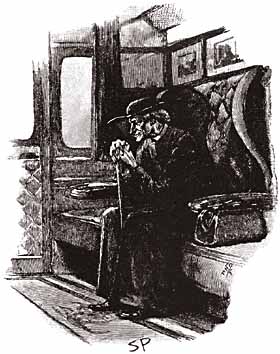
As I researched Pope Leo for my book Murder in the Vatican: The Church Mysteries of Sherlock Holmes, I discovered he held many characteristics in common with our beloved master detective. He was tall (for an Italian), painfully thin, and held to a more aesthetic lifestyle. He rarely slept, preferring his work to rest. He imbibed cocaine on occasion in a wine vintage known as Vin Mariani—and so enthusiastic was he about the wine he awarded it a gold medal and appeared on an advertisement poster for the product. He used tobacco in the form of snuff. And, I was amazed to find that Pope Leo greatly resembled Sydney Paget's illustration of Holmes in the guise of an Italian priest! Needless to say, I had a little bit of fun with that. ;)

Holmes as "the venerable Italian priest"
looking a lot like Pope Leo XIII.
Leo's Vatican home was completely devoid of a feminine presence. This was not, however, because he was a misogynist. On the contrary, he asked all women (including servants and religious) to leave the Vatican when he became pope motivated by an unusual sense of chivalry. He desired to shield them from any victimization, temptation or scandal, and to protect his priests from the same.

He was, to sum up, a man of his time as well as a man of the future. He was the most prolific pope, writing 85 encyclicals during his reign, which was the third longest in history (1878-1903). A logician himself, he was an enthusiast of St. Thomas Aquinas, whose philosophical works led to what we now know as the scientific method.

There couldn’t have been a more perfect pope, then, for whom Holmes would solve not one, but two cases (see references in BLAC and HOUN). I had great joy telling untold tales about him and the Master and I believe Holmes and Watson had a great deal of fun with him as well.

More links:


Ann Margaret Lewis is a member of the Illustrious Clients of Indianapolis. She began her writing career writing tie-in children’s books and short stories for DC Comics and Star Wars: The New Essential Guide to Alien Species, for Random House. Her book: Murder in the Vatican: The Church Mysteries of Sherlock Holmes, published by Gasogene Books, is available at Wessex Press. You can reach her at http://www.holmeschurchmysteries.com.


--

23 November 2008

"We Are in Camden House" [EMPT]

For anyone who's spent some time poking around this site, you may have frequented one of the links in the References section on the sidebar (aptly titled "His Encyclopedia of Reference"). And there, for a long time, I had linked to Camden House, a site that contained images and text from the Canon.

At some point over the last year, the site went down with no explanation. Many online Sherlockians were concerned that something might have happened to the site owner or that there were unpaid bills that they might be able to assist with. It was a site that clearly meant a great deal to people.

I'm happy to say that Camden House is no longer an Empty House. It has reopened under the same management. The site administrators share this message on the sidebar of their site:

We're back online!

For reasons I still haven't been able to get an answer on, my web provider had locked this site out. I got tired of trying to get them to respond and just wiped it out and restarted.

It's been too long.

To which I say, hear, hear! If you haven't had a chance to explore the site, please do so. There you'll find the largest collection of Holmesian graphics online, a comprehensive listing of all stories that are in the public domain, as well as a number of other nifty features that may inspire you.

It's good to see the site back again. I can think of no better quote to honor the reopening than what Sherlock Holmes himself said in"The Adventure of the Empty House,"
"Once again Mr. Sherlock Holmes is free to devote his life to examining those interesting little problems which the complex life of London so plentifully presents."
Only I'd put it this way: "Once again we are free to devote our lives to examining those interesting little pages which the comprehensive site of Camden House so plentifully presents."

25 September 2006

"...An Enthusiastic Admirer of Napoleon..." [SIXN]

Don Yates, BSI resides in St. Helena, near Napa Valley where he presides over the Napa Valley Napoleons of SH (they're on the Sherlockians Around the World map).

Don was in the news recently, as the Napa Valley Register ran a fairly good article (for a mainstream publication) about the Napoleons, titled Napa Valley Sherlock Holmes admirers meet to celebrate a life unlived.

This should serve as a nice inspiration for any Sherlockians looking to start their own societies. For existing societies and Sherlockians, here's a list of resources:

For those of you new to the Sherlock Holmes, there's a whole world of people out there like you. With just a few resources, you can be in touch with them and begin engaging on conversations about your favorite subject. Happy sleuthing!

27 June 2006

"He Had for Years Been Known as a Professional Beggar..." [TWIS]

Readers of this blog are undoubtedly aware that Neville St. Clair, in "The Man with the Twisted Lip" left his respectable job as a journalist to take up the life of a professional beggar under the nom de travail Hugh Boone.

In the June 27 installment of The Straight Dope, the question was posed to the research staff: "How much money do beggars make?"

"Data! Data! Data! I cannot make bricks without clay."

While there are little empirical data to go on, the author leads with the example from the Canon and even goes so far as to quote Leslie Klinger, BSI, editor of The New Annotated Sherlock Holmes.

21 June 2006

"Well, there is at least a curious coincidence of dates." [SPEC]

Back on April 27, we announced a Google Calendar version of the Calendar of Sherlockian Events. As it happens, that version was only open to Gmail account holders.

After some revising, Google has made it possible for non-Gmail users to view and use the calendar, so we now present the calendar in the right column of the blog. This is a particularly useful tool for traveling Sherlockians, or for scion leaders who would like to advise Web users of their events.

The calendar is still based on Ron Fish's authoritative database; there are links to both versions in the "Events"section of the main blog, which as always, you can reach by clicking on the Baker Street Blog banner at the top of your page.

20 June 2006

"I have in my pocket a manuscript," [HOUN]

For those who have not yet had the pleasure, Randall Stock runs a wonderful little Web site that, among other things, tracks the whereabouts of Conan Doyle manuscripts.

He recently announced that there has been an update to his checklist of Beeton's Christmas Annuals from 1887. Randall says:

The checklist provides lots of information about the "most expensive magazine in the world" and includes a list of the 28 confirmed copies still in existence and links to photos of five copies.
The Sherlockians and Sherlockian collectors alike would do well to take a look around Randall's site, which includes:

24 May 2006

"It Is a Hobby of Mine to Have an Exact Knowledge of London." [REDH]

DSC_9626.jpg
Recently, a reader contacted me for recommendations for incorporating Sherlock Holmes and Sir Arthur Conan Doyle into a trip to London. It's been a few years since my last trip there, but I am aware of a number of great resources out there:


These are but a smattering of books, tours, and locations. Perhaps some more well-informed traveling Sherlockian could use the Comments section below to add your own suggestions.

Image credit: amador_emmanuel34 (Flickr)

23 May 2006

"The affair seems absurdly trifling..." [SIXN]


A Trifling Reference is a "cross reference of the cases of the Consulting Detective, Mr. Sherlock Holmes, as chronicled by his friend and colleague, John H. Watson, M.D."

Some features include an entirely searchable Canon - customizable by collection or novel, with results grouped by story and with excerpts around the word or phrase for which the user searched.

In addition, the names of the 60 stories are listed in alphabetical order, with links to read the full stories. There is also a clickable link that sorts them in the order of the date of their first publication.

And finally, the major chronologies are shown side by side, and - this is a very cool and useful feature - are sortable by a clickable link at the top of each column, thus allowing the stories to be sorted in chronological order by chronologer: Bell, Christ, Zeisler, Brend, and Baring-Gould 1 and 2.

27 April 2006

"The Date Being-?" Asked Holmes. [CREE]

Ron Fish has been keeping a Sherlockian Calendar for some time - a very useful reference for those who travel or simply would like to keep track of local events.

Well now, thanks to developments at Google, we have now given the calendar an interactive design - take a look at Sherlockian events laid out in a calendar format. You can choose to look at a day, week or month at a time, or list all events in an agenda-like layout.

If you have a Gmail account, you can search the public calendars for "Sherlockian" and find ours, which is publicly available, and add it to your list of calendars. Once there, you can note your intention to attend meetings, invite others to meetings, and find useful email addresses and links.

If you would like to be able to add your own events, contact us and we'll add you to the list of approved editors of events. The more editors we have, the better the calendar will be!

If you don't have a gmail account, you are still able to be invited to meetings by others. And if you have a feedreader, you can add the Sherlockian Calendar to your feeds by dropping this link into your reader.

Please let us know what you think of this new feature!

24 April 2006

"Is He Not the Celebrated Author...?" [VALL]

A new site focused on the Literary Agent, called The Chronicles of Sir Arthur Conan Doyle is up and running. It features a Conan Doyle quote of the day, a store called the Baker Street Bazaar, and sections on Doyle's life and works.

The coolest feature is the ability to send Sherlock Holmes e-cards with Canonical quotes. There are holiday and birthday themes, and just general occasion options.

While you're at it, two other excellent Conan Doyle sites are the Arthur Conan Doyle Society and the Friends of the Arthur Conan Doyle Collection at the Toronto Public Library.


17 April 2006

"These Little Records of Our Cases Which You Have Been Good Enough to Draw Up..." [COPP]

Stanford University is sponsoring a Discovering Sherlock Holmes project, in which they seek to recreate the atmosphere of the publication of the original stories. From their web site:

Over 12 weeks from January through April 2006, Stanford will be republishing, free of charge, two early Holmes stories, "A Scandal in Bohemia" and "The Speckled Band"; the nine-part novel, The Hound of the Baskervilles; and the famous "last" encounter between Holmes and Moriarty, "The Final Problem."
Since it is now mid-April, it is too late to collect the paper versions of the stories; but they are available as PDF files on the Stanford web site, along with extensive reading notes for each issue.

In addition, there is a good deal of information about Conan Doyle and the era in which Holmes lived.

13 April 2006

"...Perhaps They Would Get My Sentence Shortened..." [SIGN]

You may have noticed these four-letter abbreviations that are showing up in our blog. A word of explanation.

Jay Finley Christ was an early member of the Baker Street Irregulars and a noted scholar. In 1947, he developed a four-letter acronym for each of the 60 tales that comprise the canon.

Our friends over at Sherlock in Peoria have put together a very nice listing of those acronyms.

Related Posts